The CE-RISE solution for Digital Passports has been developed not only as a project outcome, but for continued deployment, reuse, and further evolution beyond the project. By combining structured data models and modular software in an open approach, it supports future implementation, adaptation, and extension.
From Project Outcome to Reusable Foundation
The CE-RISE solution has been designed so that others can build on it, whether by reusing the approach as it is, adapting it to specific use cases, or extending it with additional components, services, and domain-specific elements.
This is particularly important in the area of digital passports, where long-term value depends on interoperability, flexibility, and the ability to evolve over time in response to changing needs and an evolving regulatory landscape. A solution that is open to further development can better support different sectors, different technical environments, and changing requirements.
Open Licences
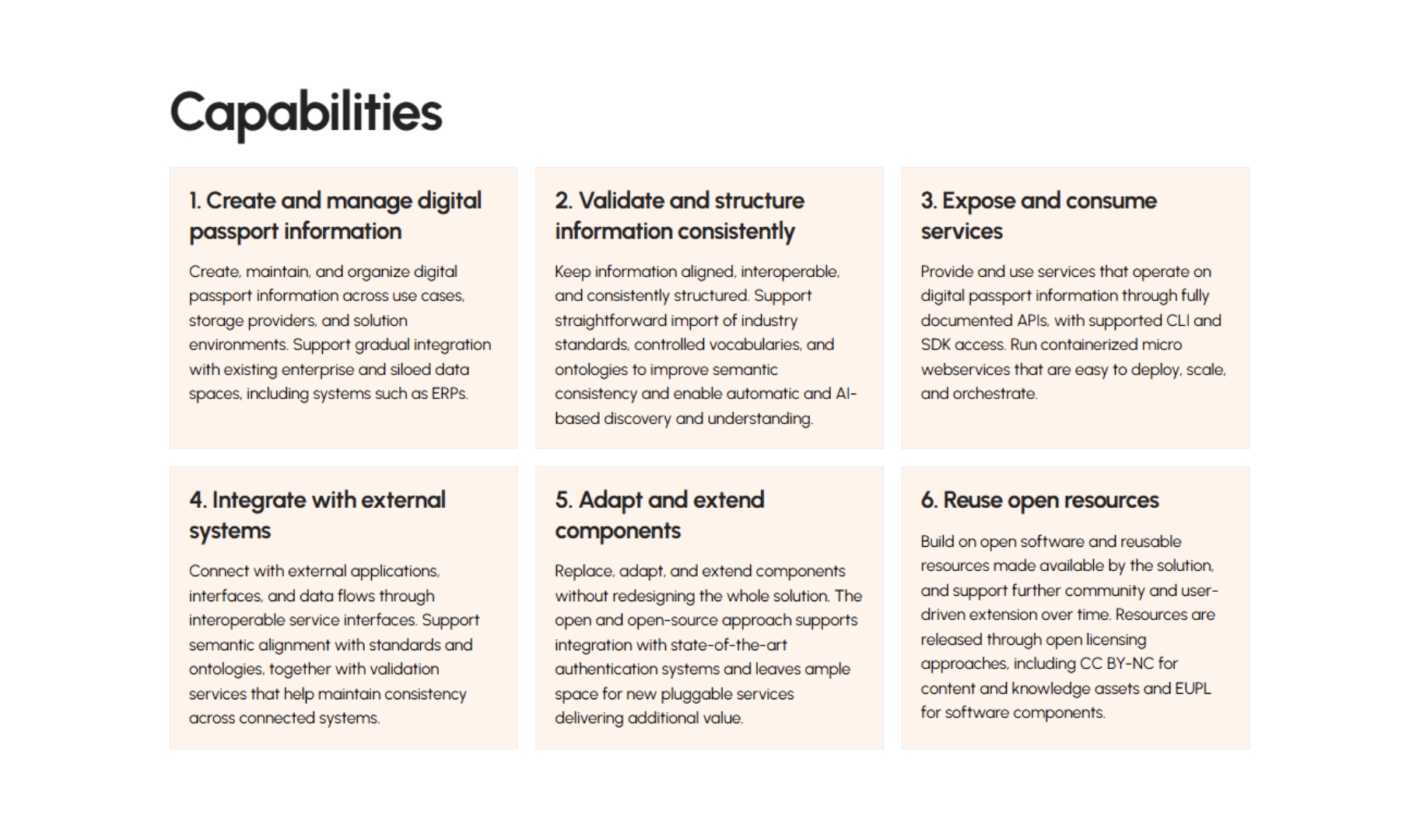
Openness is a central characteristic of the CE-RISE solution, in how it was designed and in how it is made available. Through the solution website, users can access the full scope of the project’s outputs: the overall concept, the architecture, and the technical materials, including data models, software components, and supporting documentation.
A key part of this commitment to openness is licensing. The outputs of the CE-RISE solution are explicitly licensed to support reuse, ensuring that organisations and developers can build on, adapt, and extend what has been created without unnecessary restrictions.
The vast majority of CE-RISE knowledge artefacts, including data models, project deliverables, design descriptions, and other report-based materials, are released under the Creative Commons Attribution-NonCommercial 4.0 International (CC BY-NC 4.0) licence. This allows users to copy, share, redistribute, adapt, remix, transform, and build upon these materials, provided that appropriate attribution is given and that the reuse is not for commercial purposes. CC BY-NC 4.0 does not impose a share-alike requirement, so adaptations do not have to be redistributed under the same licence, but they must still respect the non-commercial and attribution conditions.
The software developed in the project is, in most cases, released under the European Union Public Licence (EUPL) 1.2. This allows users to use, study, copy, modify, extend, combine, fork, and redistribute the software. Where modified or derivative versions of EUPL-licensed software are distributed, they must remain under the EUPL or, where applicable, under a licence recognised as compatible with it. In this sense, the EUPL is a reciprocal or copyleft licence: it supports reuse and extension, while also requiring redistributed derivatives to preserve the same openness framework, or an officially compatible one.
Together, these licensing choices support reuse across the CE-RISE solution. Knowledge artefacts can be shared and adapted for non-commercial purposes with attribution, while software components can be reused, modified, integrated, forked, and further developed under an open-source licence that preserves openness in redistributed derivatives.
Integration with Proprietary and Closed-Source Systems
The modular structure of the CE-RISE solution also supports integration with proprietary or closed-source components and platforms. This makes it possible to combine CE-RISE components with existing internal systems, third-party services, or more controlled technical environments, while still enabling them to exchange information and operate together. As a result, the solution can support open and reusable implementation building blocks without requiring an entirely open or uniform system landscape.
Publication Platforms and Long-Term Preservation
This openness is also reflected in the publication platforms used to support development, access, distribution, and long-term preservation. Software development takes place on the European code hosting platform Codeberg, while repositories are mirrored on GitHub to make access and reuse easier for broader developer communities. Packages and software releases are distributed through widely used channels such as PyPI (Python Package Index) and npm, as well as through European-based open container registries for Docker images and related deployment artefacts.
Long-term preservation is supported through versioning and release practices combined with archiving on Zenodo. This helps ensure that both knowledge artefacts and software outputs remain accessible, citable, and reusable over time, while also providing stable reference points for future uptake, validation, extension, and deployment.
Supporting Reuse and Further Development
The CE-RISE solution is already available as a concrete and deployable solution. Its data models, software components, and technical materials can be used directly by organisations, while also supporting adaptation, integration, and extension according to specific needs and contexts.
This means that the solution is not only ready for deployment today, but also structured to support continued refinement and extension over time.
At the same time, the solution is designed to continue evolving through piloting, operational use, and production experience. Its modular structure makes it possible not only to deploy the solution as it is, but also to refine components, extend functionalities, and further develop the software on the basis of real implementation and usage.
Beyond the Project
The set duration of the CE-RISE project has not been a limiting factor for the solution itself. On the contrary, the project has provided the opportunity to lay the foundations for a long-term and future-proof approach to digital passports. Through its website, technical entry points, and reusable components and materials, CE-RISE has created a basis on which project partners and the wider stakeholder community can continue to build and evolve the solution over time.
Visit solution.ce-rise.eu to explore the CE-RISE solution, access its technical entry points, and see how it can support deployment, reuse, and further development in practice.