
How a staged roadmap will determine who leads the circular electronics race by 2030
Brought to you by Joshua Aseto, CSCP
The Digital Product Passport (DPP) for electronics will not arrive as a single, fully formed solution. It will evolve in phases across complex global supply chains, and how companies navigate that evolution will define their competitive position.
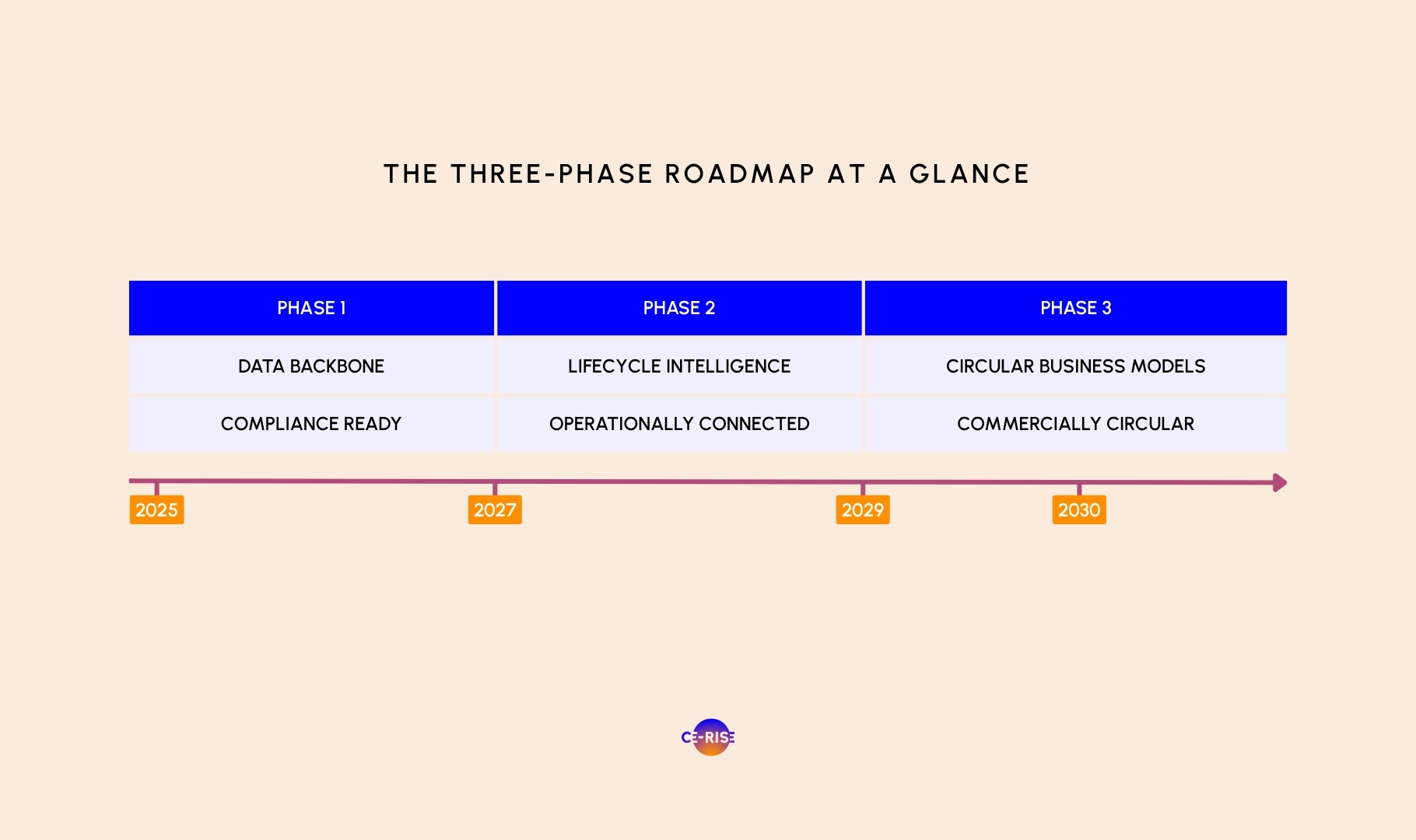
- Phase 1 is currently establishing a minimal, reliable data backbone that meets regulatory requirements without over-engineering.
- Phase 2 will transform DPPs into operational lifecycle intelligence, connecting data across systems and actors.
- Phase 3 will enable fully circular business models, repair, reuse, remanufacturing, and high-quality recycling, at scale.
Which means that producers and manufacturers that design for scalability from the outset can convert a compliance obligation into a strategic advantage in the emerging digital circular economy.
Why the DPP Will Be Phased, Not a “Big Bang”
Consider a laptop sold in 2026. By the time it returns as e-waste, its components will have passed through contract manufacturers, sub-suppliers, distributors, repair shops, and potentially a refurbisher. In most cases, no single actor has a complete, trusted view of what is inside the product, how it was used, or how best to recover its value.
This is the reality of electronics supply chains: multi-tier, globally distributed, with limited interoperability and fragmented data. Expecting a fully mature DPP to emerge overnight in this context is unrealistic. What we will see instead is a structured maturation, from minimal, compliance-driven data layers, to interconnected lifecycle intelligence, to a full circularity infrastructure that reshapes electronics business models.
Recognising this evolution is essential to avoid stranded digital investments and to align DPP strategy with broader circular economy ambitions.
Phase 1: Building the Data Backbone
Goal: Make the system work at scale, not make it perfect.
In the first wave, electronics actors need a DPP that is feasible, repeatable, and implementable across global value chains. This phase focuses on core, standardised data, including:
- Unique product identifiers (model, batch, serial number; e.g. QR codes, RFID, GS1 Digital Link)
- Key component and material composition (battery type, critical raw materials, hazardous substances)
- Core manufacturing and sourcing information (location, date, main suppliers)
- Selected environmental and safety indicators (energy efficiency, repairability score where applicable, key regulatory flags)
- Data structures aligned with emerging EU requirements under ESPR, the EU Battery Regulation, and related delegated acts
At this stage, the DPP functions primarily as a data harmonisation layer, not yet a circularity engine. Its purpose is to establish a shared language between OEMs (Original Equipment Manufacturers), EMS (Electronics Manufacturing Services) providers, component suppliers, repairers, IT asset disposition (ITAD) actors, and recyclers; interoperability between PLM/ERP systems, supplier portals, and regulatory interfaces; and the ability to perform verified reporting, traceability checks, and basic lifecycle analyses.
Companies that over-engineer Phase 1 will struggle, because supply-chain participation cannot keep pace. The success factor at this stage is simplicity, clarity, and scalability.
What This Means for You
Define your minimal data model for priority product groups (such as smartphones, laptops, servers, and network equipment). Map where this data currently lives – across internal systems, suppliers, and third-party platforms – and identify the gaps. Choose identification and access technologies that can be scaled across regions and product families. Establish internal governance: who owns product data, who maintains it, and who is authorised to share it.
Phase 2: Operational Lifecycle Intelligence
Goal: Turn static records into living digital identities.
Once a stable data foundation is in place, the DPP can evolve from static documentation to dynamic lifecycle intelligence. For electronics, this means integrating richer and more granular information, including process-level and performance data (firmware versions, known failure modes, corrective actions, safety recalls); logistics and use-phase insights (warranty claims, return reasons, operating profiles, predictive maintenance signals); links to enterprise systems (PLM – Product Lifecycle Management, ERP-Enterprise Resource Planning, service management, ITAM and ITAD tools); and increased participation from upstream component suppliers and downstream repair, refurbishment, and recycling actors.
At this point, DPPs begin to deliver tangible business value beyond regulatory compliance:
- Reduced duplication of supplier questionnaires and technical file management
- Faster, more reliable conformity and ESG reporting across markets
- Better product and interface design decisions through visibility into failure, repair, and return patterns
- Early enablement of repair, reuse, and take-back by making the right information accessible to the right actor at the right time
In Phase 2, interoperability becomes operational rather than theoretical: data is not merely stored – it is shared and applied across organisations and systems.
What This Means for You
Prioritise a focused set of high value use cases, such as reducing RMA costs, accelerating compliance audits, or enabling authorised repair. Integrate DPP data with existing tools rather than creating another disconnected solution. Pilot collaboration with a small network of repairers or ITAD partners using real product data. Define clear access rules: what can a consumer see, what can a refurbisher see, what can a recycler see?
Phase 3: Enabling New Circular Business Models
Goal: Make circularity executable, not just aspirational.
Only after reliable, scalable data exchange is in place can DPPs fulfil their most ambitious promise: enabling a circular electronics ecosystem at scale. In this mature phase, passports support:
- Automated sorting and high-quality recycling based on verified material and component intelligence
- Authentication and provenance tracking for secondary markets, helping to prevent counterfeits and enable trusted recommerce