
Brought to you by Lexmark, now part of Xerox
Across global markets, regulations are moving toward product‑level transparency, traceability, and lifecycle accountability. Emerging policy frameworks increasingly require manufacturers to provide verifiable, structured, and continuously updated product data rather than static labels or declarations.
As requirements expand across markets and product categories, Digital Product Passports (DPPs) are an emerging application of blockchain technology that enhances transparency and sustainability in the electronics industry. A DPP is a digital record that contains detailed information about a product’s lifecycle, from raw material sourcing to manufacturing, usage, and disposal.
This is why Lexmark, now part of Xerox, is a partner in the CE‑RISE (Circular Economy Resource Information System) project, an EU‑funded Horizon Europe research and innovation initiative that validates how interoperable data systems and Digital Product Passports function in practice. Through the use of printers as real‑world validation cases, Lexmark contributed operational use cases demonstrating lifecycle data management across service, returns, and end‑of‑life to support reuse, recovery, remanufacturing, and recycling.
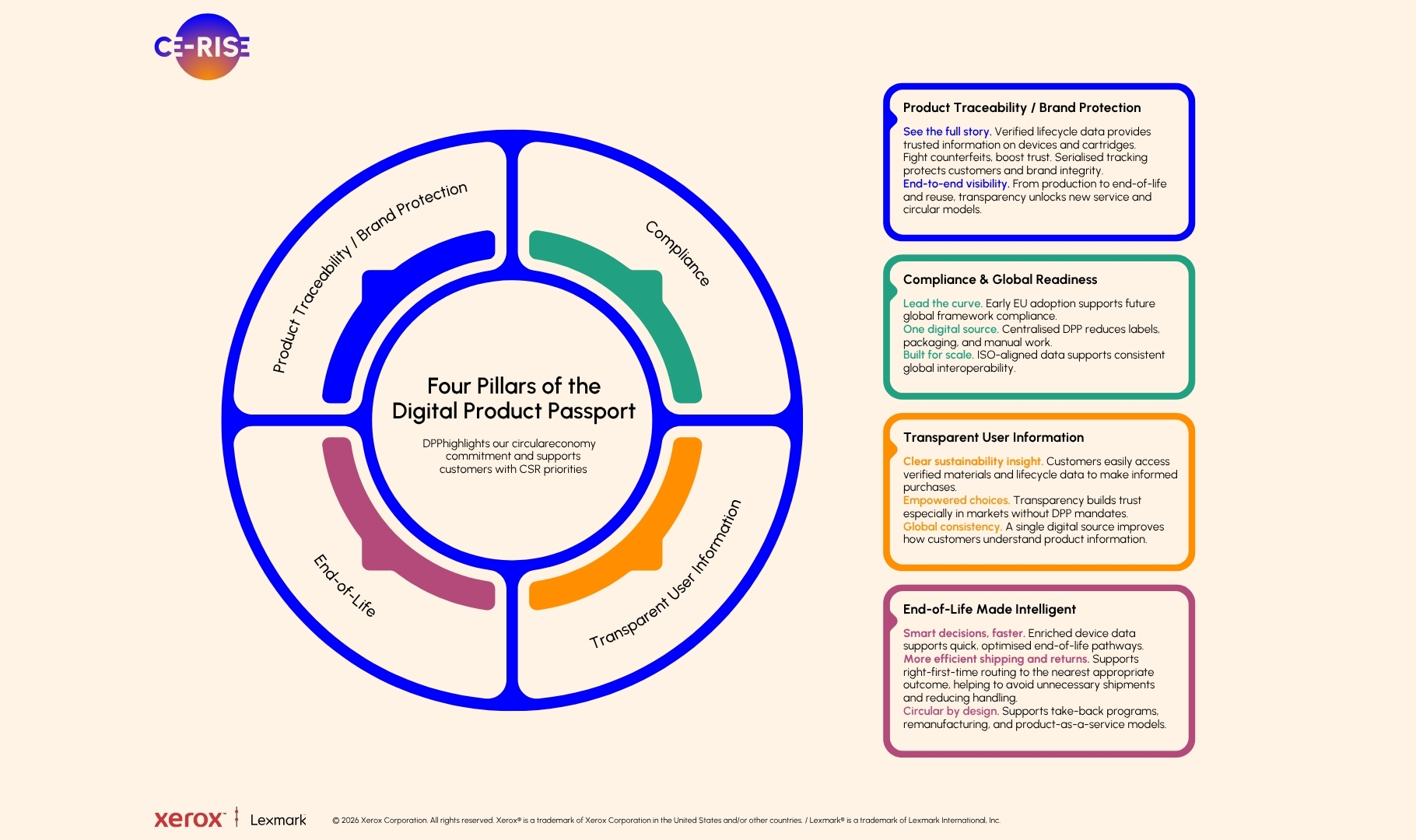
Four DPP Focus Areas
Through the CE‑RISE validation work, a clear pattern emerged around how structured product information delivers value in practice. Rather than treating DPPs as a single information set, the work highlighted four interconnected focus areas that together describe how DPP data supports transparency, compliance, and lifecycle decision‑making.
These focus areas show how organising product information in a consistent, interoperable way improves reliability, accessibility, and continuity as devices move through manufacture, use, service, and end‑of‑life. Each area reflects a different aspect of how information is used and accessed across the value chain, while remaining part of a single, connected data structure. Taken together, the four focus areas address the needs of manufacturers, service providers, recyclers, authorities, customers, and consumers, ensuring that the right information is available, in the right form, at the right point in the product lifecycle.
- Product Traceability and Brand Protection: Maintaining a reliable product identity across complex value chains is essential. Verified lifecycle data provides trusted information on devices and cartridges, supporting clearer visibility from production through end‑of‑life and reuse. End‑to‑end transparency unlocks new service and circular models while helping maintain reliable product identity across the lifecycle. Serialised tracking protects customers and brand integrity by helping fight counterfeits and boosting trust.
- Compliance and Global Readiness: Building on this transparency, structured access to product information supports regulatory and market readiness. Early EU adoption supports future global framework compliance and helps organisations lead the curve as requirements evolve. A centralised DPP reduces labels, packaging, and manual work by acting as one digital source. ISO‑aligned data supports consistent global interoperability and is built for scale.
- Transparent User Information: Structured data also shapes how product information is shared with users. Customers easily access verified materials and lifecycle data to make informed purchases and gain clear sustainability insight. Transparency builds trust, especially in markets without DPP mandates. A single digital source improves how customers understand product information and supports global consistency.
- End‑of‑Life: Clarity extends to decisions made at the end of a product’s use phase. Enriched device data supports quick, optimised end‑of‑life pathways, enabling smarter decisions, faster. Improved reverse logistics help lower waste and reduce the number of shipments, reducing environmental impact. Designed with circularity in mind, this supports take‑back programs, remanufacturing, and product‑as‑a‑service models.
DPP Relevance for Stakeholders
Together, these four focus areas demonstrate how structured product information supports different value‑chain actors:
- Manufacturers benefit from improved traceability, more consistent compliance data, and clearer end‑of‑life pathways.
- Service providers and partners gain access to accurate, item‑level product information that supports efficient service and decision‑making.
- Recyclers and recovery operators benefit from better visibility into device composition and history, supporting appropriate handling.
- Authorities and regulators can rely on structured, verifiable product data rather than fragmented documentation.
- Customers and consumers gain clearer access to verified product information that supports informed purchasing, use, and return decisions.
The capability areas show how organising product data once and maintaining it over time supports transparency, continuity, and coordination across the full lifecycle.
Supporting Regulatory Readiness with DPPs
As product regulations evolve, being compliance‑ready increasingly depends on how reliably product data can be managed, updated, and shared over time. Rather than reacting to individual regulations, DPPs allow organisations to establish a scalable data framework for product compliance, transparency, and lifecycle management.
The CE‑RISE project demonstrates that DPPs are not theoretical constructs, but practical tools that can be implemented, validated, and scaled for electronic devices, supporting regulatory readiness while improving operational efficiency and data consistency. This structured approach also enables manufacturers to deliver greater transparency, trust, and value to customers. By providing reliable lifecycle information, DPPs support informed purchasing, use, service, and end‑of‑life decisions across the product lifecycle.